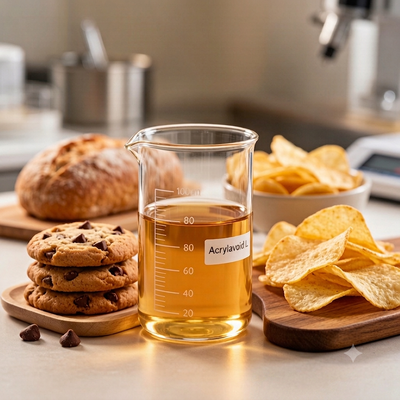
| Brand Name: | KDN BIOTECH |
| Model Number: | Asparaginase Enzyme |
| MOQ: | 25 kg |
| Price: | Negotiate |
| Payment Terms: | L/C,D/A,D/P,Western Union,T/T,MoneyGram |
Product Description
A clean-label, food-grade enzyme solution that reduces acrylamide formation by up to 90% in baked goods, potato snacks, cereals, and coffee — without altering the taste, aroma, or appearance of your product.
Acrylavoid L is a highly specific asparaginase enzyme designed as a biological processing aid for the food industry. It works by converting the amino acid asparagine — the primary precursor of acrylamide — before high-temperature processing takes place. By removing asparagine at the source, it effectively blocks the Maillard-driven reaction that produces acrylamide in baked, fried, and roasted foods.
Acrylamide is a process contaminant that forms naturally when starchy foods are cooked at temperatures above 120 °C. It has been classified as a potential carcinogen by the International Agency for Research on Cancer (IARC) and is subject to benchmark levels under EU Regulation (EU) 2017/2158. Acrylavoid L helps food manufacturers meet these regulatory targets while keeping their recipes and production processes intact.
Technical Parameters
|
Appearance |
Amber liquid |
|
Storage |
0–10 °C, cool and dry, away from direct sunlight |
|
Shelf life |
12 months under recommended conditions |
|
Packaging |
25 kg/drum |
Traditional acrylamide mitigation relies on adjusting recipes (reducing reducing sugars, changing leavening agents) or modifying process parameters (lowering temperature, extending time). These approaches often compromise the golden-brown colour, crisp texture, and rich flavour that consumers expect. Acrylavoid L offers an enzymatic, ingredient-level solution that requires no recipe reformulation and no process compromise — the enzyme does the work upstream, and the final product bakes, fries, or roasts exactly as before.
Storage Conditions
Store in a cool, dry place away from high temperature and humidity.
Shelf life: 12 months.
FAQ
Q1: What is Acrylavoid L used for?
A: Acrylavoid L is a food-grade asparaginase enzyme designed to reduce acrylamide formation in baked goods, potato products, breakfast cereals, and coffee during high-temperature processing. It converts free asparagine — the primary acrylamide precursor — before the Maillard reaction begins.
Q2: How much acrylamide can Acrylavoid L reduce?
A: Tests show Acrylavoid L can reduce acrylamide formation by 50% to 90% in cookies, soda crackers, bread, French fries, and potato chips, depending on the specific product, formulation, and processing conditions.
Q3: Does Acrylavoid L affect taste, colour, or browning?
A: No. Acrylavoid L has exceptionally high substrate specificity — it only converts asparagine while fully preserving all other amino acids and reducing sugars. This means the Maillard browning, flavour profile, aroma, and texture of the final product remain completely unchanged.
Q4: Is Acrylavoid L safe for food use?
A: Yes. The production strain is non-pathogenic and non-toxigenic. The final enzyme preparation contains no live cells and is completely heat-inactivated during subsequent high-temperature baking or frying. It is designed and produced as a food-grade processing aid in compliance with applicable regulations.
Q5: How does Acrylavoid L compare to process-based acrylamide mitigation?
A: Traditional mitigation — lowering baking temperature, reformulating recipes, switching leavening agents — often compromises colour, crispness, and flavour. Acrylavoid L works upstream at the ingredient level, removing the precursor before heat is applied. This allows manufacturers to keep their established recipes, temperatures, and production lines unchanged while still achieving regulatory compliance.
Q6: What food categories benefit most from asparaginase treatment?
A: Any starchy, high-temperature-processed food containing free asparagine and reducing sugars can benefit. The strongest and most consistent results are seen in cookies, crackers, biscuits, French fries, potato chips, breakfast cereals, and roasted coffee — all products where acrylamide is a well-documented concern.